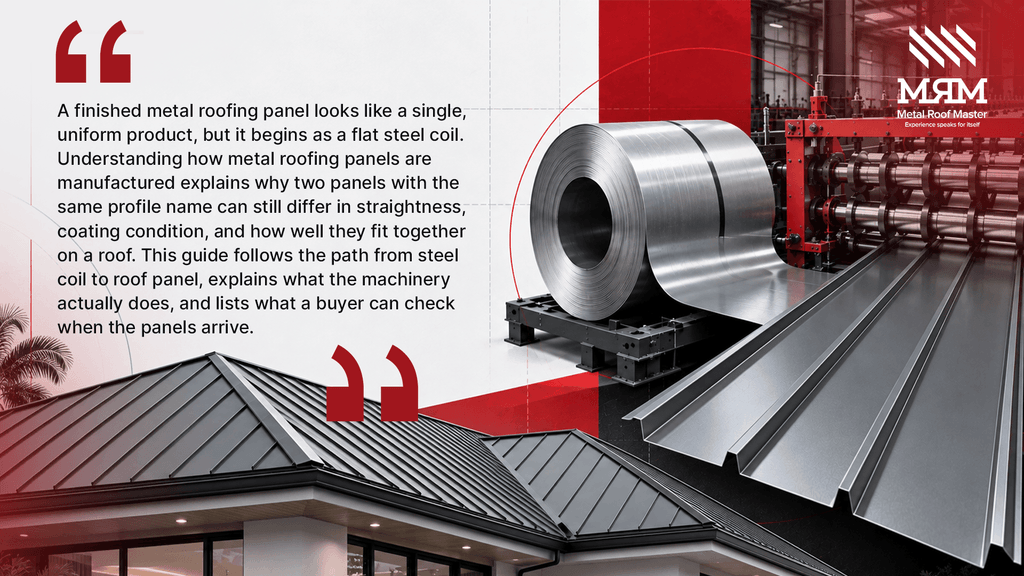
Where Every Panel Starts: The Steel Coil
Metal roofing panels are not cut from flat sheets in most production settings. They are formed from coil: a long strip of coated steel wound tightly around a core. A coil can be heavy. One trade article on the subject describes coils that can weigh more than 2,000 pounds, loaded onto the production line with a forklift or overhead hoist.
The coil arrives from a steel mill or a coating line already finished on the surface. For roofing, that usually means a metallic-coated base such as Galvalume or galvanized steel, often with a factory-applied paint system on top. The example described in that article is a 24-inch-wide Galvalume coil with a Kynar paint finish. The panel is not painted after it is formed. The finish is applied to the flat strip first, which is why coating quality at the coil stage carries straight through to the finished roof.
That has a practical consequence. The forming line cannot improve the material that enters it. If a coil has uneven thickness, a damaged coating, or poor flatness, those problems reach the panel. This is the reason serious panel manufacturers pay attention to mill-certified coil and to the coating designation on the paperwork, a point covered in more detail in our guide on what mill certified actually means.
The Roll Forming Process, Step by Step
The roll forming process is the core of metal roof panel production. It turns a flat strip into a continuous, profiled panel without stopping the material. In plain terms it works like this:
- Decoiling. The coil sits on a decoiler, a mandrel that lets it unwind smoothly as the forming line pulls the strip through.
- Feeding and guiding. The strip passes through entry guides that keep it centered. A strip that wanders at this stage produces a panel that twists or runs off-line.
- Progressive forming. The strip moves through a series of paired rollers, usually called stations. Each station bends the metal a little further. No single station creates the full profile. The shape builds up gradually, which is why the process is gentle on coatings compared with a single sharp bend.
- Cutting to length. Panels are made to the length each project requires, based on a cut list. Because the strip is continuous, the panel only becomes a separate piece when the line cuts it.
- Run-out and inspection. The finished panel moves onto a table where an operator checks it against the specification. The trade article cited at the end of this guide notes that a trained operator watches the panel throughout forming to confirm it meets spec.
That sequence is the short answer to how metal roofing panels are manufactured at most shops, and the same five steps apply whether the line makes standing seam panels or a simple corrugated profile. Because the steel is shaped gradually and continuously, roll forming is well suited to long panels with a uniform cross-section. A seam profile that must lock together over 20 feet or more needs to be the same shape at the start and the end of the panel, and the fixed sequence of rollers is what makes that repeatable.
Roll Forming Machine Basics
The word “machine” hides a fairly simple idea. A roll former is a fixed sequence of tooling plus a drive system, and understanding its main parts makes it easier to read a supplier’s description of their capability. These are roll forming machine basics worth knowing:
- Decoiler: holds and unwinds the coil.
- Entry guide: centers the strip before forming.
- Forming stations: the roller sets that shape the profile. The number of stations depends on how complex the profile is.
- Cut-off unit: shears the panel to the programmed length.
- Control system: sets panel length and quantity.
- Run-out table: supports the finished panel as it exits.
A key detail is that a roller set is built for one profile. A line making a standing seam profile cannot make a corrugated profile without different tooling. That is why a manufacturer’s catalogue of profiles is really a list of the tooling they own or can change over to.
Some manufacturing shops run panels in a fixed facility and ship them to the job. The same trade article also notes that, in some cases, panels can be formed on site with portable equipment. On-site forming is useful for very long runs, since it avoids shipping panels that would otherwise exceed transport limits. Which approach makes sense depends on the project and the crew.
From Steel Coil to Roof Panel: What Happens to Flashings and Trim
Not everything on a roof is a roll-formed panel. Some of a coil is slit or sheared into narrower strips first, and those strips become flashing, trim, and accessories. This slitting step matters because trim usually needs a different width than the main panel.
Trim pieces and flashings often have bends that a roll former is not set up to make, or are needed in small quantities. For those, manufacturers use a press brake, a machine that bends a single piece of sheet metal along one line at a time. That is why the panels and the trim on the same roof can look slightly different in finish consistency even when they come from one supplier. They were made on different equipment.
Roll Forming vs Press Braking: A Quick Comparison
| Consideration | Roll forming | Press braking |
| Material fed | Continuous coil | Individual sheets or cut blanks |
| Best suited for | Long, repeated, uniform profiles | Custom flashing, transitions, small quantities |
| How the bend is made | Many small, gradual bends in sequence | One bend per stroke, repositioned between strokes |
| Tooling | Dedicated rollers for each profile | General-purpose punch and die sets |
| Typical roofing use | Standing seam and other panel profiles | Trim, end caps, transitions |
Neither process is better in general. The choice depends on length, volume, and geometry. Most roofing jobs need both: panels from the roll former and special trim from the press brake. A buyer comparing suppliers is better served by asking whether a supplier has reliable access to both than by treating them as competing methods.
Why Coating and Thickness Affect Forming
Different coatings and thicknesses behave differently under bending. A thicker gauge needs more force and wider bend radii to avoid cracking or stressing the coating. A harder paint system can be less forgiving at tight bends. Manufacturers adjust tooling and line settings for the product they are running, and they choose coil specifications to suit the profile.
For buyers, this is a reason to look at the specification as a whole rather than at one number. Gauge, coating designation, and paint system work together. Two panels that look identical can perform differently if one used a coating that was not suited to the profile’s bends.
What a Buyer Can Check When Panels Arrive
Panel production is verifiable. Without special equipment, a buyer or installer can inspect delivered panels for signs of a well-run line:
- Straightness along the length. Lay a panel on a flat surface and sight along its edges. A panel that bows or twists points to a setup or feeding issue.
- Consistent profile at both ends. Compare the seam or rib shape at the start and the end of a panel. A shape that changes along the length suggests a tooling or alignment problem rather than normal variation.
- Coating condition. Look for scratches, scuffs, or cracking at the bends. Minor transit marks happen. Cracked paint along a bend does not.
- Clean cut ends. Burrs and heavy edge distortion at the cut can mean worn cutting tools.
- Matching panels from the same run. Panels from one production run should seam together correctly. A fit that works at one end of a panel but not the other usually points back to the line.
- Labels and paperwork. Confirm the panel profile, gauge, and finish against the order and, where relevant, against the coil’s mill certificate.
None of these checks replaces a project’s engineering or code requirements. They help catch manufacturing problems before panels reach the roof.
Questions Worth Asking a Panel Manufacturer
- Is the coil mill-certified, and can the certificate be matched to this order?
- Which coating and paint system is on the coil, and what is its designation?
- Are the panels roll formed in a fixed shop or on site, and how long can a single panel be?
- Who makes the trim and flashing, and on what equipment?
- How does the manufacturer check panels during forming?
- What is the process if panels arrive with defects?
Clear, specific answers usually signal a supplier who controls their process.
A Common Misconception: The Forming Line Fixes Coil Problems
It is tempting to assume that a good machine can compensate for weak material. It cannot. The line shapes what it is fed. Coil thickness tolerance, coating uniformity, and flatness all pass through to the finished panel. A well-set roll former on poor coil makes poor panels at high speed. That is why the supply chain behind the roof, from the mill to the coil to the line, matters as much as the machine itself. Anyone who wants to understand how metal roofing panels are manufactured, and why quality varies between suppliers, should start with the coil. Good metal roof panel production depends on consistent input, a correctly set line, and an operator who checks the output.
Frequently Asked Questions
- How are metal roofing panels manufactured? Coated steel coil is unwound, guided through a roll former that bends it gradually into the profile, and cut to the length the project needs. Trim and flashing are usually made separately, often on a press brake.
- Are metal roofing panels made from coil or from flat sheets? Most roofing panels are roll formed from coil, which allows long panels with a consistent cross-section. Flat sheets are more common for custom trim and small runs.
- What is the roll forming process in simple terms? A flat steel strip is pulled through a series of paired rollers, each bending it slightly more until the final profile forms. The panel is then cut to length.
- Why do trim and flashing sometimes look different from the panels? They are often made on a press brake from slit strips rather than on the roll former, so finish and edge quality can differ slightly.
- Can panels be made on site? In some cases, yes. Portable roll forming equipment can produce panels at the job, which is useful for very long runs. Shop production is the other common route.
- Does a thicker gauge change how panels are manufactured? Yes. Thicker material needs more force and can limit tight bends, so tooling and settings are adjusted for the gauge and coating being run.
- Where does a roll forming machine fit in a supply chain? It sits between the coil supplier and the roof. The machine determines the profile, but the coil determines the quality that carries into the finished panel.
Leave a Reply