Category: Uncategorized

  • From Steel Mill to Roof Panel: How the Metal Roofing Supply Chain Works

    From Steel Mill to Roof Panel: How the Metal Roofing Supply Chain Works

    Most people see a metal roof as a finished product: panels on a house. Behind each panel is a chain of steps that starts at a steel mill, passes through coating and painting lines, moves through distributors and fabricators, and ends at a roll former and a job site. Understanding that chain helps a buyer ask better questions about quality, price and timing. This article gives the metal roofing supply chain explained in plain steps, using published industry sources, and shows where delays and risk tend to appear.

    It is an overview. Real supply chains differ by company, product and year, and the figures below come from the cited sources, not from a single standard process.

    The Metal Roofing Supply Chain Explained at a Glance

    A common path for a painted steel roofing panel looks like this:

    1. Steel production. A mill makes steel and rolls it into coil.
    2. Metallic coating. The coil is coated with zinc or an aluminum-zinc alloy.
    3. Painting, if any. The coated coil is cleaned, primed and painted on a coil coating line.
    4. Slitting and processing. Wide master coils are cut to the widths customers need.
    5. Distribution. Material moves through a supplier or distributor to a fabricator.
    6. Roll forming. A roll former shapes the coil into panels.
    7. Delivery and installation. Panels and accessories go to the job site.

    Each step adds time, cost and a chance of delay. We take them in turn.

    Step 1: Steel Production and Coil

    Roofing panels are usually made from steel that starts as a flat product, rolled thin and coiled for shipping. The Metal Construction Association (MCA) white paper “Metal Roofing from A (Aluminum) to Z (Zinc)” notes that carbon steel is a common roofing base for cost reasons, though it corrodes unless protected by a coating. Steel coil production at a mill involves many stages. For a buyer, the important point is that the base steel and its thickness are set here, and everything else builds on them.

    Thickness is described by gauge, which runs backwards, so a lower number is thicker metal. One supplier’s published chart lists a minimum of about 0.023 inches for 24 gauge Galvalume and about 0.018 inches for 26 gauge. Charts differ slightly, so a quote should state the actual thickness.

    Step 2: Metallic Coating

    Bare steel rusts, so roofing steel receives a metallic coating. According to the MCA paper, the coating is applied in a continuous hot-dip process: the mill cleans, degreases, rinses and dries the coil, pickles it in acid and preheats it, then passes it through molten metal at roughly 800 to 1,100 degrees Fahrenheit. Air knives control the coating thickness, and the coil is cooled, dried and recoiled. The paper gives the line speed as about 800 linear feet per minute.

    The main roofing coatings it describes include:

    • Galvanized (zinc). Designated G-30, G-60 and G-90 by coating weight, with G-90 the common choice for prepainted roofing steel.
    • Galvalume (about 55 percent aluminum, 43.4 percent zinc, 1.6 percent silicon). Available as AZ50, AZ55 and AZ60. The paper says AZ55 is usually warranted for 25 years and is the leading unpainted option.

    The coating designation tells a buyer how much coating is on the steel, so it should appear on the quote, the order and the mill certificate. For more detail, see our guides on Galvalume and galvanized coatings and on ASTM standards for metal roofing.

    Step 3: Coil Coating and Paint

    If the panel will be painted, the coated coil goes to a coil coating line. Sheffield Metals, a coil and sheet supplier, describes the process in its overview: the material is cleaned, pretreated, primed, painted and dried in an oven. It names PVDF as the primary coating system, with SMP also available, and notes that custom colors cost extra and carry longer lead times. Because that is a supplier’s own description, treat it as one example of how a company handles painting, not a rule for every supplier.

    Paint systems differ in how they weather and fade, and the finish warranty depends on the system. That is why a color name alone is not a specification.

    Step 4: Slitting and Processing

    Coating lines work on wide “master” coils. Sheffield’s overview says its master coils come in 40-inch and 48-inch widths, which are slit to narrower standard sizes, for example 20-inch coils from 40-inch masters and 16-inch and 24-inch coils from 48-inch masters. Coils are sold in sets because several slit coils come from one master, and non-standard widths can carry extra fees.

    This is why a buyer who needs an unusual width may wait longer or pay more. Processing decisions are made here, and they feed directly into lead times for roofing steel.

    Step 5: Distribution and Metal Roofing Sourcing

    After coating and slitting, material moves from a mill or processor to a distributor, a regional branch or a fabricator. Metal roofing sourcing decisions happen here: which mill, which coating line, which supplier and which warehouse.

    Sourcing affects three things a buyer cares about:

    • Consistency. Coils from one source and one paint batch match better than coils from several.
    • Traceability. The mill test certificate and coil tags should let you trace the material.
    • Availability. Stock and processing capacity near the job shorten delivery.

    For related reading on the origin side, see our guides on country of origin and section 232 tariffs.

    Step 6: Roll Forming

    At a roll forming shop, coil is fed through a series of rollers that shape it into the panel profile. The MCA paper makes two points that matter for quality: roll forming is the typical method of making roofing panels, and Galvalume warranties call for a minimum bend radius of 2T, since brake forming can cause premature corrosion at tension bend lines. It also notes that welding removes the coating, and a field repair does not match the original coating’s protection.

    For how panels are made from coil in more depth, see our article on how metal roofing panels are manufactured.

    Step 7: Delivery and Installation

    Panels and accessories travel from the roll former to the job site, where they are unloaded, stored and installed. Handling here affects the finish, and delivery timing affects the schedule. A delay anywhere upstream usually shows up as a delay here.

    Lead Times for Roofing Steel: Where They Come From

    As the metal roofing supply chain explained above shows, every step adds time.

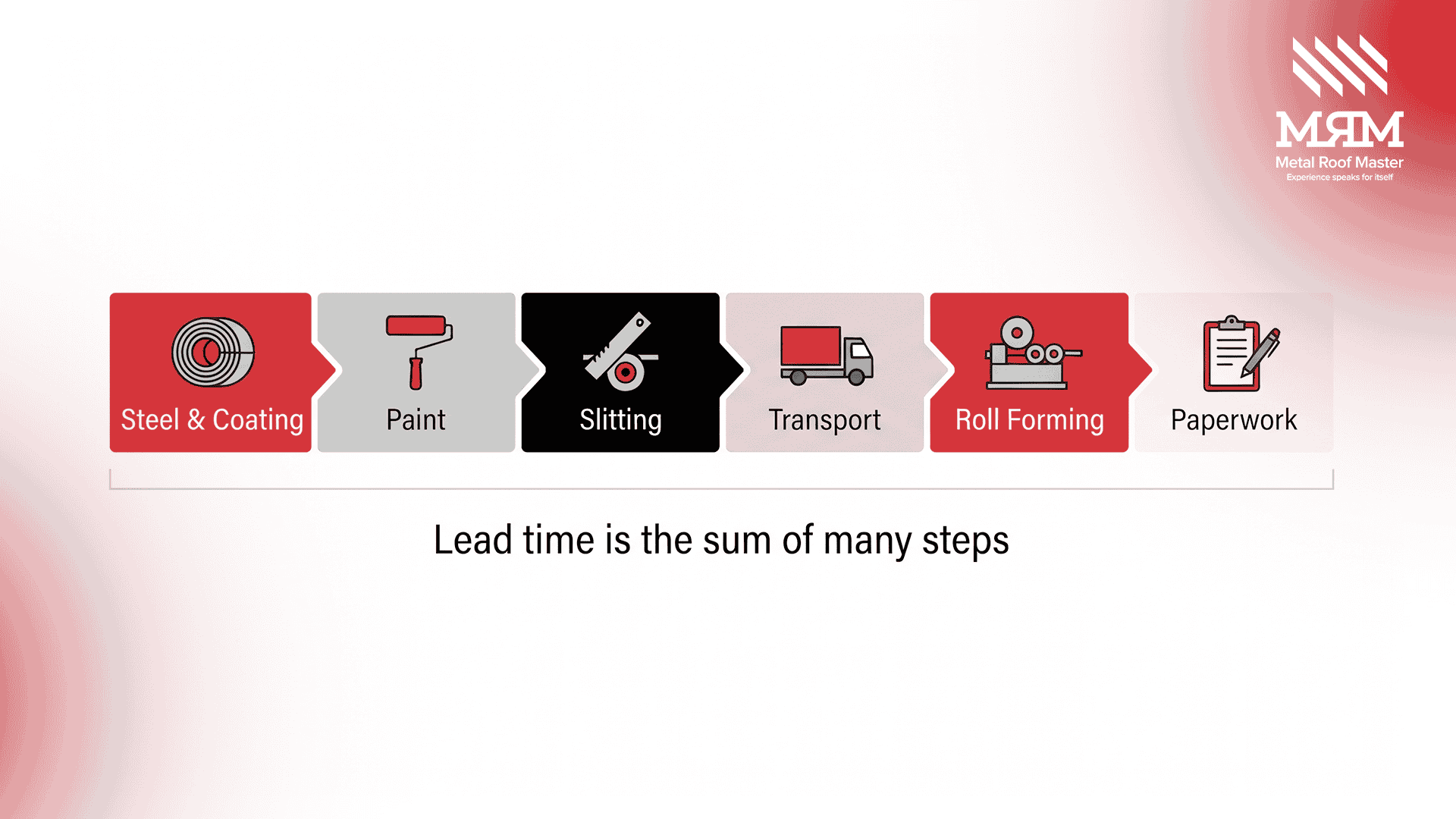
    Lead times are not a single number. They are the sum of several parts:

    • Availability of the base steel and coating. If the mill or the coating line is busy, the order waits.
    • Paint and color. Standard colors move faster than custom colors, according to the Sheffield overview.
    • Slitting and processing. Non-standard widths or quantities add time.
    • Transport. Trucking, ports and receiving docks add days, and holiday weeks tighten schedules.
    • Roll forming and fabrication. A shop’s backlog affects when panels are made.
    • Approvals and paperwork. Documents and permits can pace a project as much as the steel.

    For this reason, a quoted lead time is only useful when it says what it covers and what could change it.

    Supply Chain Risk: What Can Go Wrong

    Supply chain risk is the chance that one step fails or changes. Common examples:

    • Price changes. Steel prices, tariffs and freight costs can change between quote and order, so ask how long a quote holds.
    • Delays. Mill, port, trucking or paint delays move the whole schedule.
    • Substitution. A supplier may swap one coating weight or paint batch for another if stock runs short. Insist on written specifications.
    • Documentation mismatch. A certificate that does not match the order is a red flag.
    • Single-source dependence. Relying on one mill or one supplier increases exposure.

    None of these is a reason to avoid metal roofing. They are reasons to ask who supplies the steel, what the specification is and what happens if something changes.

    Questions to Ask a Supplier

    1. Where does the steel come from, and which coating line and paint system are used?
    2. What is the exact thickness, coating designation and finish?
    3. What documents come with the material, and how are they matched to the order?
    4. What is the lead time, what does it cover and what could change it?
    5. How long is the quote valid, and how do price changes work?
    6. What happens if the specified material is not available?

    Common Misunderstandings

    “All Galvalume is the same.” The name describes a type of coating. Coating weight, thickness and paint vary.

    “Lead time is a fixed number.” It is the sum of many steps, and any of them can change.

    “A local supplier means local steel.” A local branch may sell coil that was made and coated elsewhere. Ask where the material comes from.

    “A certificate is optional.” The certificate is how you check that the material matches the order.

    Where to Go Next

    For related reading on this site, see our guides on how metal roofing panels are manufactured, country of origin for roofing steel, ASTM standards for metal roofing and how steel tariffs affect roofing prices. For coated steel coil, see mrmsteel.ai. For installation and local options in Miami-Dade, visit metalroofmaster.com.

    Frequently Asked Questions

    What is the metal roofing supply chain? It is the path from the steel mill to the roof: steel production, metallic coating, painting, slitting, distribution, roll forming, delivery and installation.

    How does steel coil production affect a roof? The base steel, its thickness and its coating are set before the panel is made, and they determine how the roof performs and how it is priced.

    What are typical lead times for roofing steel? There is no single figure. Lead times depend on stock, coating and paint, processing, transport and the roll former’s backlog, so ask each supplier what its number covers.

    What is metal roofing sourcing? It is the choice of where the steel, coating, paint and panels come from: which mill, which processor, which supplier and which fabricator.

    What supply chain risk should a buyer watch for? Price changes, delays, material substitution, mismatched documents and dependence on a single source. Written specifications and matching certificates reduce the risk.
  • Are Metal Roofs Energy Efficient in Hot Climates?

    Are Metal Roofs Energy Efficient in Hot Climates?

    Are metal roofs energy efficient? Ask the question and you will hear a confident yes from some sources and a careful “it depends” from others. Both have a point. Metal can be an excellent roofing material for keeping a building cool, but the savings do not come from the metal alone. They come from how much sunlight the surface reflects, how well it sheds heat, and what sits between the roof and the living space. This guide explains the main ideas, what a well-known Florida study found, and how to judge a claim before you rely on it.

    Start With Two Properties

    When engineers describe how a roof handles the sun, they use two measurements.

    • Solar reflectance. This is the share of sunlight a surface reflects instead of absorbing. A roof with high solar reflectance stays cooler in the sun.
    • Thermal emittance. This is how well a surface gives off heat as infrared radiation. A roof with high emittance sheds absorbed heat more readily.

    The U.S. Department of Energy describes a cool roof as one that reflects more sunlight and absorbs less, and notes that most cool roofs also have high thermal emittance. It compares the idea to wearing light-colored clothing on a sunny day. Under the same sun, the department says, a conventional roof can reach 150°F or more on a summer afternoon, while a reflective roof could stay more than 50°F cooler.

    Here is the point that surprises people: according to the same Department of Energy page, unpainted metals are good solar reflectors but poor thermal emitters, so bare metal is not the department’s first recommendation for a cool roof. What makes a metal roof perform in the sun is usually its coating or paint, not the bare steel or aluminum underneath.

    Cool Metal Roofing: What the Term Means

    There is no single legal definition of a cool roof. The Department of Energy says qualifications vary by standard or program, location, building type and roof slope. In practice, cool metal roofing usually means a metal panel with a coating or paint system that has been tested for solar reflectance and thermal emittance.

    The Cool Roof Rating Council (CRRC) maintains a Rated Products Directory that lists solar reflectance and thermal emittance values for thousands of roofing products. If a manufacturer claims a solar reflectance metal roof rating, you can look for a rated value instead of relying on a brochure’s adjectives.

    Three habits make claims easier to judge:

    • Ask for the tested values, not just the word “cool.”
    • Check whether the values are initial or aged, since surfaces change with weather and dirt.
    • Confirm that the number applies to the exact color and finish you are buying.

    Reflective Roof Coatings and Dark Colors

    Most of the energy performance of a painted metal roof sits in the paint. Reflective roof coatings are formulated to bounce more sunlight back, and the pigments used determine how much a color reflects. Light colors reflect the most. Dark colors usually reflect less, which is why a dark roof is generally hotter than a light one on a sunny day.

    That does not make a dark metal roof a poor choice. It means the roof system around it matters more. Some manufacturers offer dark colors made with reflective pigments that reflect more sunlight than a conventional dark pigment of the same shade. Whether a given product does is something to confirm in writing, with test values, not to assume.

    What a Florida Study Found

    The best-known measured data for hot, humid climates comes from the Florida Solar Energy Center. In a study published in November 2000 (FSEC-CR-1220-00), researchers compared seven side-by-side homes in Fort Myers, Florida, over July 8 to 31, 2000. The homes were unoccupied, each had R-19 ceiling insulation, and each had a different roof: standard dark shingles as the control, light shingles, a sealed attic with roof-deck insulation, white tile roofs, terra cotta tile and a white metal roof.

    The reported results:

    • The control home’s attic reached a peak summer-hour temperature about 40°F above the outdoor air temperature. The highly reflective roofs stayed no hotter than the outside air.
    • The white metal roof showed 29.4 percent measured cooling energy savings and a 39.7 percent demand reduction over the test period.
    • Other systems fell between: light shingles saved 10.2 percent, a sealed attic saved 13.5 percent, and terra cotta tile saved 5.9 percent.
    • For a typical South Florida home, the authors estimated the white metal roof would save about 1,610 kilowatt-hours a year, around 23 percent of cooling use.

    These are real numbers, and they show that a highly reflective roof can make a big difference in a hot climate. They also come with limits. The study was done at one site, for one month, in unoccupied homes. The white metal roof was a highly reflective one, so the results say little about dark roofs. And the study was funded by Florida Power & Light with the Department of Energy, which the authors disclose. Treat the figures as one well-documented data point, not a guarantee for any particular house.

    Metal Roof Energy Savings: What Else Matters

    A roof’s surface is only one part of how much heat reaches a house. Several other factors decide actual metal roof energy savings:

    • Attic ventilation. Moving hot air out of the attic reduces how much heat builds up under the roof.
    • Insulation. Ceiling insulation slows heat flow from the attic into the living space. The Florida study found a sealed attic with roof-deck insulation also saved energy, though less than a highly reflective roof.
    • Underlayment and air gap. The layers under metal panels, and the gap between the panels and the deck, affect heat transfer. Some underlayments use reflective or radiant barrier properties.
    • Air conditioning efficiency and use. A house with a more efficient system saves less in absolute terms from a cooler roof.
    • Climate. The Department of Energy notes that cool roofs deliver the greatest cooling savings in hot climates, while in cold climates a winter heating penalty can outweigh them.

    This is why a good answer to “are metal roofs energy efficient” always comes with a follow-up question: compared with what, and in which house?

    Caveats the Department of Energy Raises

    The Department of Energy page is useful partly because it lists the downsides:

    • Savings depend on climate, insulation, roof type and HVAC efficiency.
    • A cool roof can cause a heating penalty in winter.
    • Converting a good existing roof to a cool roof can be expensive.
    • In warm, moist places, algae or mold stains can show more on light roofs.

    None of these is a reason to avoid a reflective roof in a hot climate. They are reasons to look at your own house instead of a generic claim.

    A Simple Way to Judge a Claim

    So, are metal roofs energy efficient enough to justify the claim on a brochure? Use the steps below.

    When a supplier or contractor says a roof is energy efficient, try this short sequence:

    1. Ask what the claim is based on. A tested solar reflectance and emittance value is stronger than a general statement.
    2. Check the product, color and finish. A rating for one color does not apply to another.
    3. Ask about the whole system. Underlayment, ventilation and insulation belong in the conversation.
    4. Ask what is guaranteed. Energy savings usually are not, and a supplier who promises a specific percentage is guessing.
    5. Compare against your own bills. Your house, your insulation and your air conditioning decide the real result.

    Common Misconceptions

    “Are metal roofs energy efficient by default?” No. Efficiency depends on the coating and the system, not the metal alone.

    “Any metal roof is a cool roof.” Bare metal reflects well but sheds heat poorly. The coating decides how a painted metal roof performs.

    “A dark roof will always make the house hot.” A dark roof absorbs more sunlight, but ventilation, insulation and underlayment decide how much heat enters the house.

    “The study proves metal saves 30 percent.” The 29.4 percent figure was a one-month measurement on a white metal roof in unoccupied test homes in one Florida city. It is evidence, not a promise.

    “Reflective means maintenance free.” Surfaces collect dirt and age, which can change reflectance over time.

    Where to Go Next

    For related reading on this site, see our guides on metal roofing in humid climates, roof ventilation basics for metal roofing, and what PPGL and the PVDF coating mean. For installation and local options in Miami-Dade, visit metalroofmaster.com. For coated steel coil, see mrmsteel.ai.

    Frequently Asked Questions

    Are metal roofs energy efficient? They can be, especially in hot climates, when the panel has a reflective coating and the roof system includes good ventilation and insulation. Bare metal alone is not what delivers the savings.

    What is cool metal roofing? It is a metal roof with a coating or paint system that has been tested for high solar reflectance and thermal emittance. Programs and standards define it in different ways.

    What is solar reflectance on a metal roof? It is the share of sunlight that the roof surface reflects instead of absorbing. A higher value means a cooler roof under the same sun.

    How much can a metal roof save on cooling? It depends on the house and the roof. A Florida Solar Energy Center study measured 29.4 percent cooling energy savings for a white metal roof over one July test period, but results vary by house, climate and roof color.

    Is a dark metal roof a bad idea in a hot climate? Not necessarily. Dark colors reflect less sunlight, so ask about reflective pigment options and focus on ventilation, underlayment and insulation.

  • 24 Gauge vs 26 Gauge Metal Roofing: What Changes?

    What Gauge Means, and Why the Numbers Run Backwards

    Gauge is a thickness designation that dates back to the wire and sheet trades. For steel sheet, the number runs in the opposite direction from what most people expect: a higher gauge number means thinner metal. A 26 gauge panel is thinner than a 24 gauge panel, and a 29 gauge panel is thinner still.

    The number itself does not carry a single, universal thickness. Different charts exist for different materials, and the same gauge number can correspond to a slightly different thickness for galvanized steel, uncoated steel, aluminum, or stainless steel. Some charts list nominal thickness, others list minimum thickness, and some include the metallic coating while others do not. That is why two sources can disagree by a few thousandths of an inch without either being wrong.

    For roofing, the practical lesson is to ask for the actual thickness in decimal inches or millimeters, and to ask whether it is a nominal or a minimum value. A quote that says only “24 gauge” leaves room for interpretation.

    A Simple Gauge Chart for Roof Panels

    One coil supplier that publishes thickness figures for Galvalume steel lists a minimum thickness of about 0.023 inches for 24 gauge and about 0.018 inches for 26 gauge. On that basis, 24 gauge is roughly 28 percent thicker than 26 gauge. This gauge chart is a reference point for Galvalume-coated roofing steel, not a universal rule:

    GaugeApproximate minimum thickness (Galvalume steel, one supplier)Where you often see it
    24About 0.023 inEngineered standing seam systems, commercial and higher-spec residential roofs
    26About 0.018 inMany residential panels and lighter-duty profiles

    Lighter gauges also exist. Thinner panels, such as 29 gauge, appear on lower-cost exposed fastener profiles. If a quote lists a number you do not recognize, ask for the decimal thickness and compare it directly.

    24 Gauge vs 26 Gauge Metal Roof: What Differs on the Roof

    The practical differences fall into six areas.

    Rigidity and oil canning. Thicker metal is stiffer. Oil canning is the visible waviness that can appear in flat areas of a metal panel, and it has several causes, including coil stress, forming, handling, and installation. A thicker panel resists it better. That does not make a 26 gauge panel unacceptable, but it can matter on large flat pans and on dark finishes where waviness shows.

    Denting. Thinner metal dents more easily from hail, foot traffic, falling branches, and handling during installation. It is worth knowing that an impact rating is a different property from dent resistance. A panel can pass an impact test for cracking and still show dents.

    Wind and storm performance. Wind resistance depends on the complete system: panel, clip, fastener, deck, and attachment. Some engineered panel systems are tested and published only at 24 gauge, which is why 24 gauge is commonly specified for high-wind regions. Where a roof must meet a specific approval, the gauge, clip, and fastening pattern listed in the approval document control what can be installed.

    Forming and installation. A thinner panel is easier to bend, cut, and roll form. Thicker material is only slightly harder in the hands of an experienced crew, but the difference shows up in tooling, line speed, and in how forgiving a tight bend is.

    Cost. Thicker steel costs more per square foot because it contains more metal. One supplier estimates that 26 gauge coil is roughly 8 to 15 percent less expensive than 24 gauge. Treat figures like that as a general range, since steel prices move and installation, trim, and labor are separate lines.

    Weight. A thicker panel weighs more. On most roofs the difference is small compared with the weight of the structure, but handling long panels is easier with the lighter gauge.

    A Worked Example: Same Roof, Two Quotes

    Picture a simple gable roof covered in long standing seam panels, quoted twice. Quote A lists 26 gauge panels at a lower price. Quote B lists 24 gauge panels at a higher price. A buyer reading only the totals sees a price gap and nothing else. A buyer doing a proper metal roof gauge comparison asks what the gap buys.

    On this roof, the 24 gauge quote buys a stiffer pan, which helps keep long flat areas from showing waviness in strong sun. It may also be the gauge listed in the approval for the clip and fastening pattern the roof requires. The 26 gauge quote saves money, and if the approval allows the lighter gauge on that profile, it can be a sound choice. The right call comes from checking the approval document and the profile, not from assuming that either number is better. When you set a 24 gauge vs 26 gauge metal roof quote side by side, make sure everything else on the quote is also the same: coating, paint, clips, trim, and underlayment.

    Metal roofing thickness also affects what happens after installation. A thinner panel is more sensitive to rough handling on the job site and to foot traffic during later maintenance. That is a reason to keep traffic on the roof to a minimum and to follow the manufacturer’s guidance on where it is safe to walk.

    Side-by-Side Summary

    Consideration24 gauge26 gauge
    ThicknessThicker (about 28% more than 26)Thinner
    Stiffness and oil canning resistanceHigherLower
    Dent resistanceBetterMore susceptible
    Storm-rated system availabilityCommon minimum for engineered systemsAvailable, though fewer tested systems
    Ease of forming and installingSlightly harderEasier
    Material costHigherLower

    Gauge Is Only Part of the Specification

    A heavier gauge does not make up for a weak coating or the wrong paint system. Roofing steel is protected by a metallic coating, and often by paint on top. Two coating families dominate roofing coil. Galvanized steel is covered under ASTM A653, which is zinc-based. Aluminum-zinc coated steel, sold as Galvalume, is covered under ASTM A792, with a coating that is roughly 55 percent aluminum, about 43 percent zinc, and a small amount of silicon. Each specification has coating weight designations, and heavier coating weight generally means longer corrosion life.

    Paint matters too. Some lighter-gauge products use a silicone-modified polyester (SMP) paint, which is generally considered less durable than PVDF. When a quote compares a 26 gauge panel with SMP paint to a 24 gauge panel with PVDF paint, the gauge is only one of two differences. Our guide to what PPGL is and why the PVDF coating matters covers paint systems in more detail.

    For a broader look at coating choices, see our guide on GI vs Galvalume vs ZAM: the real difference explained.

    Why the Roof Panel Gauge May Be Fixed by the System You Choose

    Many buyers assume gauge is a free choice. In practice, the panel profile, the clip, and the approval often limit it. A standing seam system tested and approved for wind uplift is approved as an assembly: a specific panel, thickness, clip type, fastener, deck, and installation pattern. Changing the roof panel gauge can place the installation outside what was tested, even if the substitute seems stronger or equivalent.

    In places such as the High-Velocity Hurricane Zone in Miami-Dade and Broward counties, the product approval document and the local building official decide what is acceptable. Before approving a change in gauge, ask the manufacturer and the building official whether the approval allows it.

    Which Gauge Fits Which Situation?

    The right answer depends on the project. These are general patterns, not rules:

    • Large flat pans, dark colors, or long panels: thicker gauge reduces visible waviness and improves rigidity.
    • High-wind regions or engineered systems: follow the tested system, which is often 24 gauge.
    • Budget-driven residential work on simple profiles: 26 gauge can be a reasonable choice when the profile and approval allow it and the finish is solid.
    • Areas with hail or heavy foot traffic: thicker metal dents less easily.
    • Coastal installations: coating, paint, fasteners, and detailing often matter more than a single gauge step.

    Whichever gauge is chosen, a roof is only as good as its weakest component. A properly specified 26 gauge system can outperform a poorly specified 24 gauge one.

    A Common Misconception: Thicker Is Always Better

    It is tempting to assume that a thicker panel is automatically a better roof. Thicker steel is stiffer and dents less easily, but it adds cost and is not always an option within an approved system. A mismatch between gauge and the rest of the system can hurt more than it helps. For example, a heavy panel on a clip that was designed for a lighter one can place unexpected loads on the connection. The better question is whether the whole system, including gauge, coating, paint, clips, deck, and installation, meets the requirement. That is the real purpose of a metal roof gauge comparison: to turn a single number on a quote into a set of questions about the system behind it.

    How to Read a Quote or Spec Sheet

    When comparing quotes, line up these items:

    1. Gauge and decimal thickness, and whether the figure is nominal or minimum
    2. Base metal and coating designation, such as the ASTM standard and coating weight
    3. Paint system, with the name and warranty terms
    4. Panel profile, clip, and fastener type
    5. Approval or test report, where the project requires one
    6. Mill certificate, tying the coil to the tested properties

    Our guide on what mill certified actually means explains what the certificate should show.

    Questions to Ask Before Ordering

    • What is the actual thickness in decimal inches, and is it nominal or minimum?
    • Is the panel galvanized or Galvalume, and what is the coating designation?
    • Which paint system is on the coil?
    • Is this gauge the one listed in the approval or test report for this system?
    • How does this gauge affect clip type and fastening?
    • Can I see a mill certificate for the coil?

    Frequently Asked Questions

    • What should a metal roof gauge comparison include? Thickness in decimal inches, base metal and coating designation, paint system, clip and fastener type, and the approval or test report for the system. Gauge alone is not enough.
    • Is 24 gauge or 26 gauge better for a metal roof? It depends on the project. 24 gauge is thicker, stiffer, and more resistant to denting and oil canning, and it is a common minimum for engineered storm-rated systems. 26 gauge is easier to form and install and costs less. The roof system and approval often decide.
    • What does roof panel gauge mean? Gauge is a thickness designation for sheet metal. A higher number means thinner metal. The exact thickness depends on the material and the chart used, so ask for decimal thickness.
    • How thick is 24 gauge metal roofing? One supplier lists about 0.023 inches minimum for 24 gauge Galvalume steel. Other charts may differ slightly, so confirm with your supplier.
    • Is metal roofing thickness the only factor in durability? No. A thicker panel resists denting and waviness better, but durability also depends on coating, paint, fasteners, and installation.
    • Is the gauge chart the same for every metal? No. A gauge chart is specific to a material and a convention, so the same gauge number can mean slightly different thicknesses for steel, aluminum, or stainless. Ask for decimal thickness.
    • Do coating and paint matter as much as gauge? Yes. Coating type and weight, paint system, fasteners, and installation all affect lifespan. A thicker panel with a weak coating can fail earlier than a thinner one with a strong coating.
    • Can I swap one gauge for another on an approved system? Not automatically. Approvals apply to a tested assembly. Ask the manufacturer and the building official before changing the gauge.
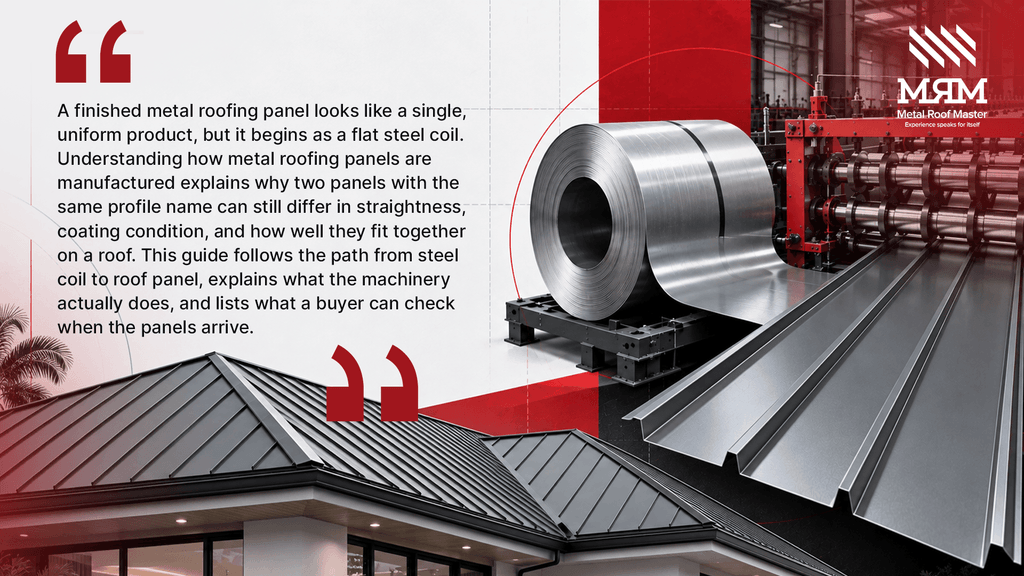
  • How Metal Roofing Panels Are Made From Steel Coil

    Where Every Panel Starts: The Steel Coil

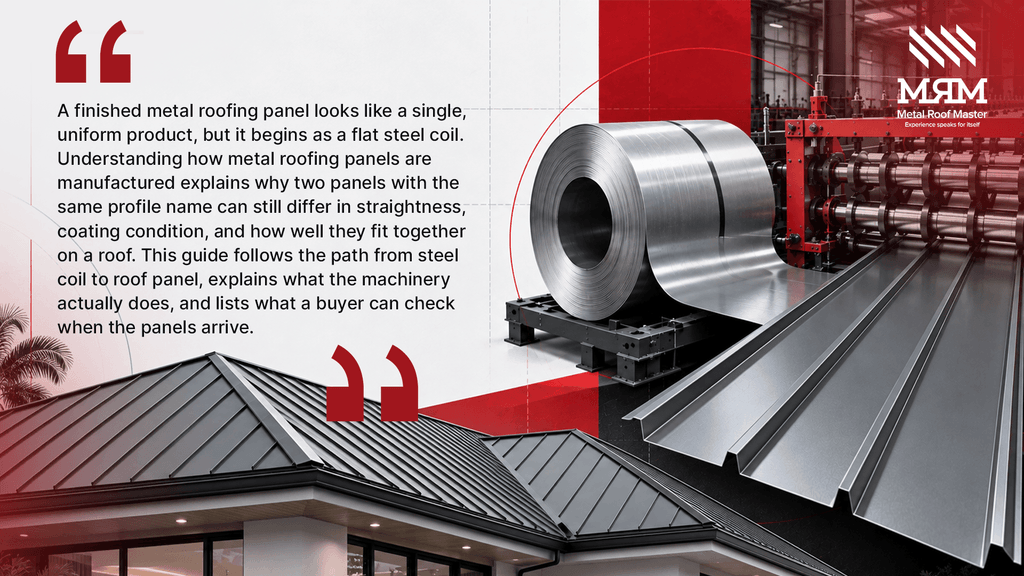
    Metal roofing panels are not cut from flat sheets in most production settings. They are formed from coil: a long strip of coated steel wound tightly around a core. A coil can be heavy. One trade article on the subject describes coils that can weigh more than 2,000 pounds, loaded onto the production line with a forklift or overhead hoist.

    The coil arrives from a steel mill or a coating line already finished on the surface. For roofing, that usually means a metallic-coated base such as Galvalume or galvanized steel, often with a factory-applied paint system on top. The example described in that article is a 24-inch-wide Galvalume coil with a Kynar paint finish. The panel is not painted after it is formed. The finish is applied to the flat strip first, which is why coating quality at the coil stage carries straight through to the finished roof.

    That has a practical consequence. The forming line cannot improve the material that enters it. If a coil has uneven thickness, a damaged coating, or poor flatness, those problems reach the panel. This is the reason serious panel manufacturers pay attention to mill-certified coil and to the coating designation on the paperwork, a point covered in more detail in our guide on what mill certified actually means.

    The Roll Forming Process, Step by Step

    The roll forming process is the core of metal roof panel production. It turns a flat strip into a continuous, profiled panel without stopping the material. In plain terms it works like this:

    1. Decoiling. The coil sits on a decoiler, a mandrel that lets it unwind smoothly as the forming line pulls the strip through.
    2. Feeding and guiding. The strip passes through entry guides that keep it centered. A strip that wanders at this stage produces a panel that twists or runs off-line.
    3. Progressive forming. The strip moves through a series of paired rollers, usually called stations. Each station bends the metal a little further. No single station creates the full profile. The shape builds up gradually, which is why the process is gentle on coatings compared with a single sharp bend.
    4. Cutting to length. Panels are made to the length each project requires, based on a cut list. Because the strip is continuous, the panel only becomes a separate piece when the line cuts it.
    5. Run-out and inspection. The finished panel moves onto a table where an operator checks it against the specification. The trade article cited at the end of this guide notes that a trained operator watches the panel throughout forming to confirm it meets spec.

    That sequence is the short answer to how metal roofing panels are manufactured at most shops, and the same five steps apply whether the line makes standing seam panels or a simple corrugated profile. Because the steel is shaped gradually and continuously, roll forming is well suited to long panels with a uniform cross-section. A seam profile that must lock together over 20 feet or more needs to be the same shape at the start and the end of the panel, and the fixed sequence of rollers is what makes that repeatable.

    Roll Forming Machine Basics

    The word “machine” hides a fairly simple idea. A roll former is a fixed sequence of tooling plus a drive system, and understanding its main parts makes it easier to read a supplier’s description of their capability. These are roll forming machine basics worth knowing:

    • Decoiler: holds and unwinds the coil.
    • Entry guide: centers the strip before forming.
    • Forming stations: the roller sets that shape the profile. The number of stations depends on how complex the profile is.
    • Cut-off unit: shears the panel to the programmed length.
    • Control system: sets panel length and quantity.
    • Run-out table: supports the finished panel as it exits.

    A key detail is that a roller set is built for one profile. A line making a standing seam profile cannot make a corrugated profile without different tooling. That is why a manufacturer’s catalogue of profiles is really a list of the tooling they own or can change over to.

    Some manufacturing shops run panels in a fixed facility and ship them to the job. The same trade article also notes that, in some cases, panels can be formed on site with portable equipment. On-site forming is useful for very long runs, since it avoids shipping panels that would otherwise exceed transport limits. Which approach makes sense depends on the project and the crew.

    From Steel Coil to Roof Panel: What Happens to Flashings and Trim

    Not everything on a roof is a roll-formed panel. Some of a coil is slit or sheared into narrower strips first, and those strips become flashing, trim, and accessories. This slitting step matters because trim usually needs a different width than the main panel.

    Trim pieces and flashings often have bends that a roll former is not set up to make, or are needed in small quantities. For those, manufacturers use a press brake, a machine that bends a single piece of sheet metal along one line at a time. That is why the panels and the trim on the same roof can look slightly different in finish consistency even when they come from one supplier. They were made on different equipment.

    Roll Forming vs Press Braking: A Quick Comparison

    ConsiderationRoll formingPress braking
    Material fedContinuous coilIndividual sheets or cut blanks
    Best suited forLong, repeated, uniform profilesCustom flashing, transitions, small quantities
    How the bend is madeMany small, gradual bends in sequenceOne bend per stroke, repositioned between strokes
    ToolingDedicated rollers for each profileGeneral-purpose punch and die sets
    Typical roofing useStanding seam and other panel profilesTrim, end caps, transitions

    Neither process is better in general. The choice depends on length, volume, and geometry. Most roofing jobs need both: panels from the roll former and special trim from the press brake. A buyer comparing suppliers is better served by asking whether a supplier has reliable access to both than by treating them as competing methods.

    Why Coating and Thickness Affect Forming

    Different coatings and thicknesses behave differently under bending. A thicker gauge needs more force and wider bend radii to avoid cracking or stressing the coating. A harder paint system can be less forgiving at tight bends. Manufacturers adjust tooling and line settings for the product they are running, and they choose coil specifications to suit the profile.

    For buyers, this is a reason to look at the specification as a whole rather than at one number. Gauge, coating designation, and paint system work together. Two panels that look identical can perform differently if one used a coating that was not suited to the profile’s bends.

    What a Buyer Can Check When Panels Arrive

    Panel production is verifiable. Without special equipment, a buyer or installer can inspect delivered panels for signs of a well-run line:

    • Straightness along the length. Lay a panel on a flat surface and sight along its edges. A panel that bows or twists points to a setup or feeding issue.
    • Consistent profile at both ends. Compare the seam or rib shape at the start and the end of a panel. A shape that changes along the length suggests a tooling or alignment problem rather than normal variation.
    • Coating condition. Look for scratches, scuffs, or cracking at the bends. Minor transit marks happen. Cracked paint along a bend does not.
    • Clean cut ends. Burrs and heavy edge distortion at the cut can mean worn cutting tools.
    • Matching panels from the same run. Panels from one production run should seam together correctly. A fit that works at one end of a panel but not the other usually points back to the line.
    • Labels and paperwork. Confirm the panel profile, gauge, and finish against the order and, where relevant, against the coil’s mill certificate.

    None of these checks replaces a project’s engineering or code requirements. They help catch manufacturing problems before panels reach the roof.

    Questions Worth Asking a Panel Manufacturer

    • Is the coil mill-certified, and can the certificate be matched to this order?
    • Which coating and paint system is on the coil, and what is its designation?
    • Are the panels roll formed in a fixed shop or on site, and how long can a single panel be?
    • Who makes the trim and flashing, and on what equipment?
    • How does the manufacturer check panels during forming?
    • What is the process if panels arrive with defects?

    Clear, specific answers usually signal a supplier who controls their process.

    A Common Misconception: The Forming Line Fixes Coil Problems

    It is tempting to assume that a good machine can compensate for weak material. It cannot. The line shapes what it is fed. Coil thickness tolerance, coating uniformity, and flatness all pass through to the finished panel. A well-set roll former on poor coil makes poor panels at high speed. That is why the supply chain behind the roof, from the mill to the coil to the line, matters as much as the machine itself. Anyone who wants to understand how metal roofing panels are manufactured, and why quality varies between suppliers, should start with the coil. Good metal roof panel production depends on consistent input, a correctly set line, and an operator who checks the output.

    Frequently Asked Questions

    • How are metal roofing panels manufactured? Coated steel coil is unwound, guided through a roll former that bends it gradually into the profile, and cut to the length the project needs. Trim and flashing are usually made separately, often on a press brake.
    • Are metal roofing panels made from coil or from flat sheets? Most roofing panels are roll formed from coil, which allows long panels with a consistent cross-section. Flat sheets are more common for custom trim and small runs.
    • What is the roll forming process in simple terms? A flat steel strip is pulled through a series of paired rollers, each bending it slightly more until the final profile forms. The panel is then cut to length.
    • Why do trim and flashing sometimes look different from the panels? They are often made on a press brake from slit strips rather than on the roll former, so finish and edge quality can differ slightly.
    • Can panels be made on site? In some cases, yes. Portable roll forming equipment can produce panels at the job, which is useful for very long runs. Shop production is the other common route.
    • Does a thicker gauge change how panels are manufactured? Yes. Thicker material needs more force and can limit tight bends, so tooling and settings are adjusted for the gauge and coating being run.
    • Where does a roll forming machine fit in a supply chain? It sits between the coil supplier and the roof. The machine determines the profile, but the coil determines the quality that carries into the finished panel.
  • Hello world!

    Welcome to WordPress. This is your first post. Edit or delete it, then start writing!