Most people see a metal roof as a finished product: panels on a house. Behind each panel is a chain of steps that starts at a steel mill, passes through coating and painting lines, moves through distributors and fabricators, and ends at a roll former and a job site. Understanding that chain helps a buyer ask better questions about quality, price and timing. This article gives the metal roofing supply chain explained in plain steps, using published industry sources, and shows where delays and risk tend to appear.
It is an overview. Real supply chains differ by company, product and year, and the figures below come from the cited sources, not from a single standard process.
The Metal Roofing Supply Chain Explained at a Glance
A common path for a painted steel roofing panel looks like this:
- Steel production. A mill makes steel and rolls it into coil.
- Metallic coating. The coil is coated with zinc or an aluminum-zinc alloy.
- Painting, if any. The coated coil is cleaned, primed and painted on a coil coating line.
- Slitting and processing. Wide master coils are cut to the widths customers need.
- Distribution. Material moves through a supplier or distributor to a fabricator.
- Roll forming. A roll former shapes the coil into panels.
- Delivery and installation. Panels and accessories go to the job site.
Each step adds time, cost and a chance of delay. We take them in turn.
Step 1: Steel Production and Coil
Roofing panels are usually made from steel that starts as a flat product, rolled thin and coiled for shipping. The Metal Construction Association (MCA) white paper “Metal Roofing from A (Aluminum) to Z (Zinc)” notes that carbon steel is a common roofing base for cost reasons, though it corrodes unless protected by a coating. Steel coil production at a mill involves many stages. For a buyer, the important point is that the base steel and its thickness are set here, and everything else builds on them.
Thickness is described by gauge, which runs backwards, so a lower number is thicker metal. One supplier’s published chart lists a minimum of about 0.023 inches for 24 gauge Galvalume and about 0.018 inches for 26 gauge. Charts differ slightly, so a quote should state the actual thickness.
Step 2: Metallic Coating
Bare steel rusts, so roofing steel receives a metallic coating. According to the MCA paper, the coating is applied in a continuous hot-dip process: the mill cleans, degreases, rinses and dries the coil, pickles it in acid and preheats it, then passes it through molten metal at roughly 800 to 1,100 degrees Fahrenheit. Air knives control the coating thickness, and the coil is cooled, dried and recoiled. The paper gives the line speed as about 800 linear feet per minute.
The main roofing coatings it describes include:
- Galvanized (zinc). Designated G-30, G-60 and G-90 by coating weight, with G-90 the common choice for prepainted roofing steel.
- Galvalume (about 55 percent aluminum, 43.4 percent zinc, 1.6 percent silicon). Available as AZ50, AZ55 and AZ60. The paper says AZ55 is usually warranted for 25 years and is the leading unpainted option.
The coating designation tells a buyer how much coating is on the steel, so it should appear on the quote, the order and the mill certificate. For more detail, see our guides on Galvalume and galvanized coatings and on ASTM standards for metal roofing.
Step 3: Coil Coating and Paint
If the panel will be painted, the coated coil goes to a coil coating line. Sheffield Metals, a coil and sheet supplier, describes the process in its overview: the material is cleaned, pretreated, primed, painted and dried in an oven. It names PVDF as the primary coating system, with SMP also available, and notes that custom colors cost extra and carry longer lead times. Because that is a supplier’s own description, treat it as one example of how a company handles painting, not a rule for every supplier.
Paint systems differ in how they weather and fade, and the finish warranty depends on the system. That is why a color name alone is not a specification.
Step 4: Slitting and Processing
Coating lines work on wide “master” coils. Sheffield’s overview says its master coils come in 40-inch and 48-inch widths, which are slit to narrower standard sizes, for example 20-inch coils from 40-inch masters and 16-inch and 24-inch coils from 48-inch masters. Coils are sold in sets because several slit coils come from one master, and non-standard widths can carry extra fees.
This is why a buyer who needs an unusual width may wait longer or pay more. Processing decisions are made here, and they feed directly into lead times for roofing steel.
Step 5: Distribution and Metal Roofing Sourcing
After coating and slitting, material moves from a mill or processor to a distributor, a regional branch or a fabricator. Metal roofing sourcing decisions happen here: which mill, which coating line, which supplier and which warehouse.
Sourcing affects three things a buyer cares about:
- Consistency. Coils from one source and one paint batch match better than coils from several.
- Traceability. The mill test certificate and coil tags should let you trace the material.
- Availability. Stock and processing capacity near the job shorten delivery.
For related reading on the origin side, see our guides on country of origin and section 232 tariffs.
Step 6: Roll Forming
At a roll forming shop, coil is fed through a series of rollers that shape it into the panel profile. The MCA paper makes two points that matter for quality: roll forming is the typical method of making roofing panels, and Galvalume warranties call for a minimum bend radius of 2T, since brake forming can cause premature corrosion at tension bend lines. It also notes that welding removes the coating, and a field repair does not match the original coating’s protection.
For how panels are made from coil in more depth, see our article on how metal roofing panels are manufactured.
Step 7: Delivery and Installation
Panels and accessories travel from the roll former to the job site, where they are unloaded, stored and installed. Handling here affects the finish, and delivery timing affects the schedule. A delay anywhere upstream usually shows up as a delay here.
Lead Times for Roofing Steel: Where They Come From
As the metal roofing supply chain explained above shows, every step adds time.
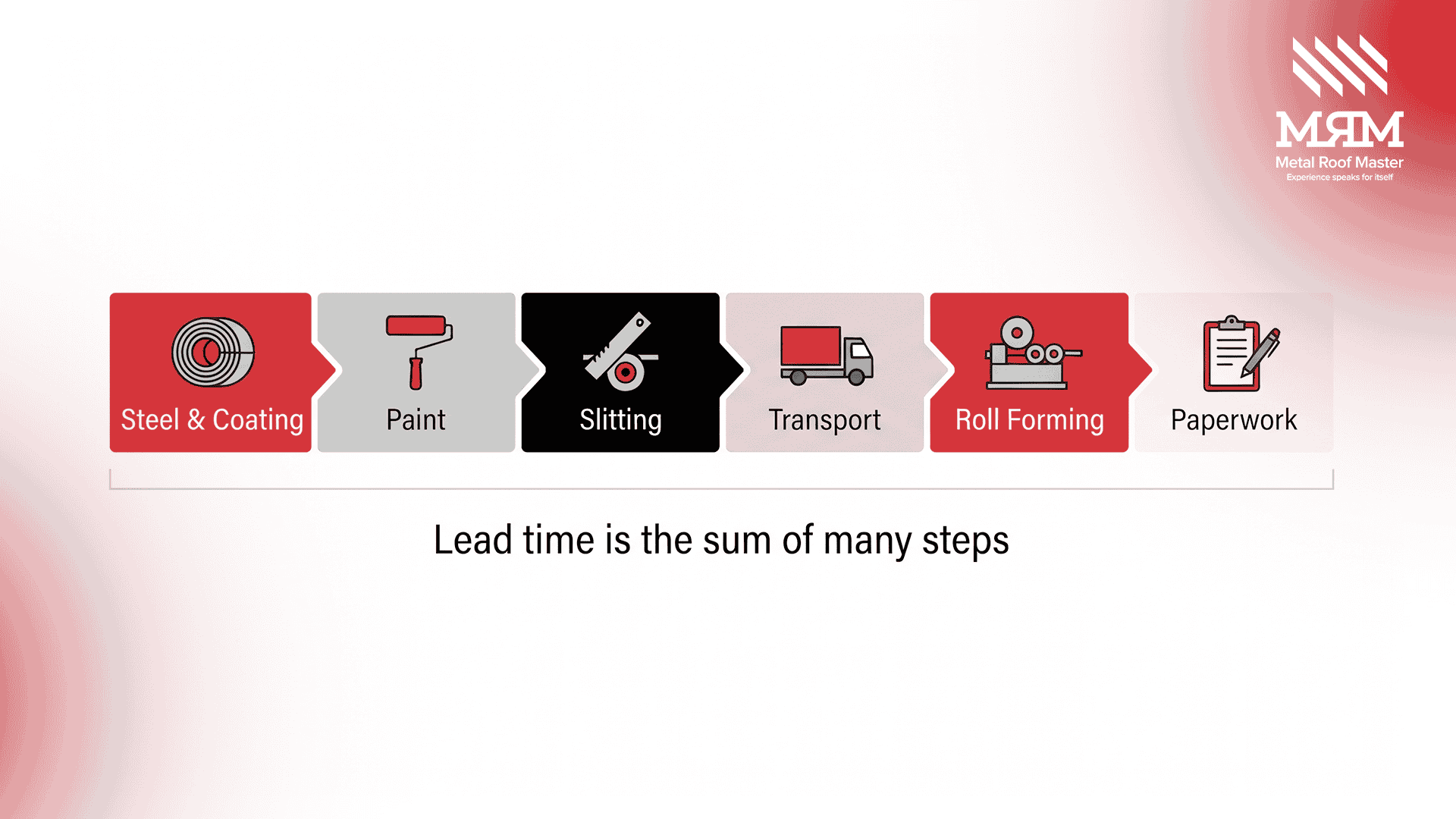
Lead times are not a single number. They are the sum of several parts:
- Availability of the base steel and coating. If the mill or the coating line is busy, the order waits.
- Paint and color. Standard colors move faster than custom colors, according to the Sheffield overview.
- Slitting and processing. Non-standard widths or quantities add time.
- Transport. Trucking, ports and receiving docks add days, and holiday weeks tighten schedules.
- Roll forming and fabrication. A shop’s backlog affects when panels are made.
- Approvals and paperwork. Documents and permits can pace a project as much as the steel.
For this reason, a quoted lead time is only useful when it says what it covers and what could change it.
Supply Chain Risk: What Can Go Wrong
Supply chain risk is the chance that one step fails or changes. Common examples:
- Price changes. Steel prices, tariffs and freight costs can change between quote and order, so ask how long a quote holds.
- Delays. Mill, port, trucking or paint delays move the whole schedule.
- Substitution. A supplier may swap one coating weight or paint batch for another if stock runs short. Insist on written specifications.
- Documentation mismatch. A certificate that does not match the order is a red flag.
- Single-source dependence. Relying on one mill or one supplier increases exposure.
None of these is a reason to avoid metal roofing. They are reasons to ask who supplies the steel, what the specification is and what happens if something changes.
Questions to Ask a Supplier
- Where does the steel come from, and which coating line and paint system are used?
- What is the exact thickness, coating designation and finish?
- What documents come with the material, and how are they matched to the order?
- What is the lead time, what does it cover and what could change it?
- How long is the quote valid, and how do price changes work?
- What happens if the specified material is not available?
Common Misunderstandings
“All Galvalume is the same.” The name describes a type of coating. Coating weight, thickness and paint vary.
“Lead time is a fixed number.” It is the sum of many steps, and any of them can change.
“A local supplier means local steel.” A local branch may sell coil that was made and coated elsewhere. Ask where the material comes from.
“A certificate is optional.” The certificate is how you check that the material matches the order.
Where to Go Next
For related reading on this site, see our guides on how metal roofing panels are manufactured, country of origin for roofing steel, ASTM standards for metal roofing and how steel tariffs affect roofing prices. For coated steel coil, see mrmsteel.ai. For installation and local options in Miami-Dade, visit metalroofmaster.com.
Frequently Asked Questions
What is the metal roofing supply chain? It is the path from the steel mill to the roof: steel production, metallic coating, painting, slitting, distribution, roll forming, delivery and installation.
How does steel coil production affect a roof? The base steel, its thickness and its coating are set before the panel is made, and they determine how the roof performs and how it is priced.
What are typical lead times for roofing steel? There is no single figure. Lead times depend on stock, coating and paint, processing, transport and the roll former’s backlog, so ask each supplier what its number covers.
What is metal roofing sourcing? It is the choice of where the steel, coating, paint and panels come from: which mill, which processor, which supplier and which fabricator.
What supply chain risk should a buyer watch for? Price changes, delays, material substitution, mismatched documents and dependence on a single source. Written specifications and matching certificates reduce the risk.
Leave a Reply